
Landing page conversions stall when the copy is vague, generic, or hard to scan. A landing page copy generator helps you get to a strong first draft in minutes, so you can test faster, iterate faster, and stop publishing pages that sound acceptable but do not convert.
How a landing page copy generator fits into your workflow
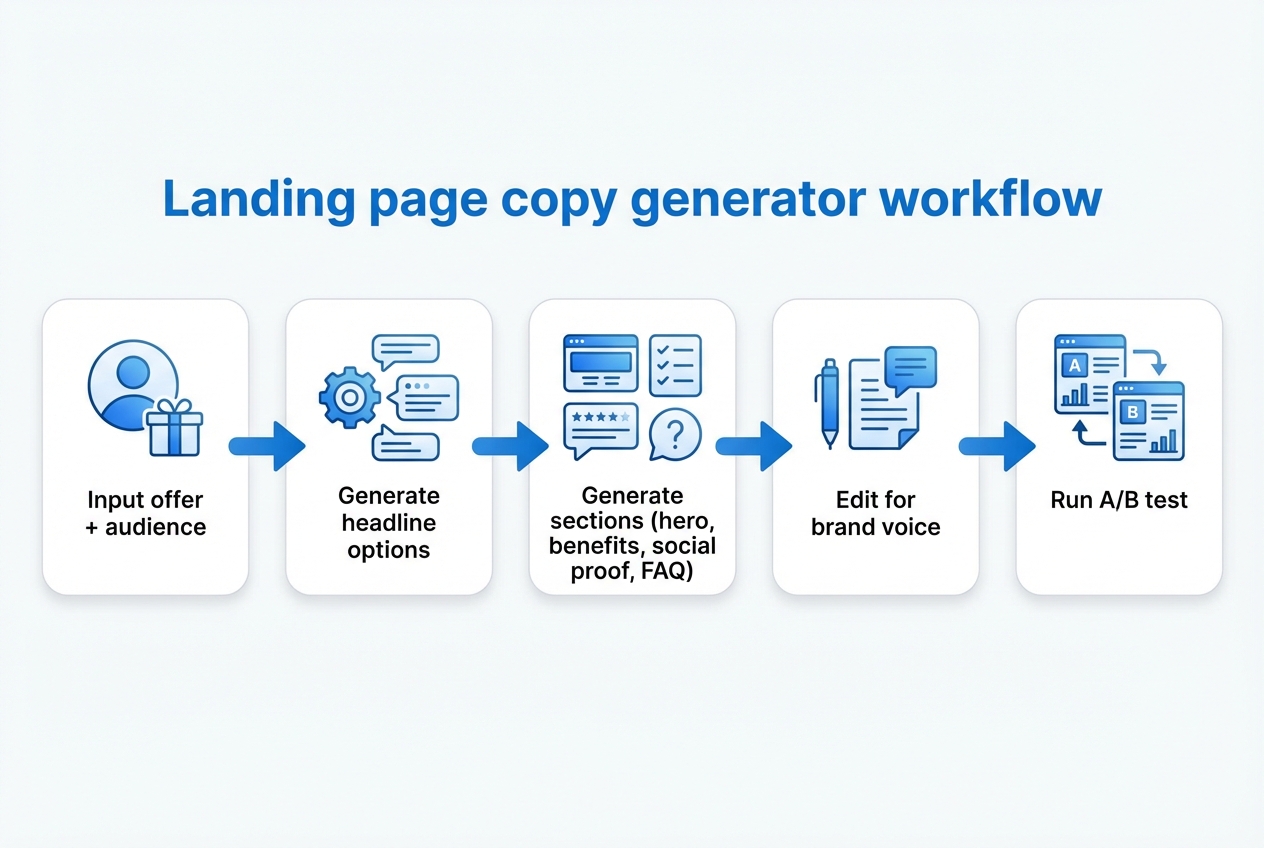
Treat a generator like a drafting partner. You still own the final judgment.
The fastest teams use it to create options, then validate with real users.
- Start with a tight brief: Define the offer, audience, and one primary action (your call to action (CTA)).
- Generate variants on purpose: Ask for 10 headline options, 5 subheads, 3 hero sections, and 5 button labels.
- Edit for clarity and specificity: Replace vague claims with concrete outcomes, constraints, and proof.
- Ship a test first: Run A/B testing (split testing) on the hero headline and CTA first.
If you are validating an idea, pair your copy workflow with a lightweight build plan. our 90-day roadmap is a solid framework for turning “I think this could work” into a real product without burning months. If the landing page is part of a broader ops push, the playbook in automating business processes helps you connect marketing learnings to real workflow leverage.
What to look for in a landing page copy generator
The best tool is the one that matches your workflow, your compliance needs, and how often you publish.
- Brand voice control: You should be able to enforce terminology, tone, and “never say this” rules, otherwise every draft needs heavy rewrites.
- Structured landing page outputs: Look for tools that can generate sections (hero, benefits, social proof, objections, frequently asked questions) rather than one big blob.
- Collaboration and reuse: Versioning, shared libraries, and team workflows matter once more than one person touches the page.
- Scannability support: Strong landing pages are built for skim readers. Nielsen Norman Group’s guidance on concise, scannable web writing is the standard worth following.
- CTA quality: Your generator should produce CTA options that are action-forward and benefit-led. Mailchimp’s examples of effective call-to-action patterns are a practical reference.
- Accessibility basics: Button and link text should be descriptive, not “Learn more.” The Web Content Accessibility Guidelines (WCAG) explain why link purpose must be clear from text or context.
12 best landing page copy generator tools
Jasper
Jasper is a strong choice for teams that need on-brand landing pages at scale. It is best when you want consistent voice across ads, emails, and the landing page those campaigns drive to.
Copy.ai
Copy.ai works well when a landing page is one asset inside a broader go-to-market system. Use it for benefit bullets, alternate angles, and section drafts you can hand to design.
Writesonic
Writesonic is purpose-built for landing page drafts, so you get usable structure fast. It is a good fit when you want “good enough to launch” copy quickly, then refine with real data.
Anyword
Anyword stands out for teams that want guidance on which variation is more likely to perform before publishing. It is best when you are producing many versions of the same page for different audiences.
HubSpot Campaign Assistant
HubSpot’s AI Landing Page Copy Generator is a clean option if your Customer Relationship Management (CRM) and marketing stack already live in HubSpot. It is especially useful for quick campaigns where speed matters.
Instapage AI Content
Instapage AI content generation is ideal if you want copy generation inside the same tool where you build and experiment on pages. It keeps iteration tight between copy and layout.
Unbounce Smart Copy
Unbounce Smart Copy was useful for quick rewrites inside a landing-page workflow. Note: Unbounce states the standalone Smart Copy product was discontinued on January 28, 2026, so treat this as a legacy option and verify availability before committing.
Leadpages AI Engine
Leadpages AI Engine is a strong “build + write” combo for founders who want templates and fast publishing. It is useful when your bottleneck is shipping pages quickly.
Wix AI Website Builder
Wix AI Website Builder is helpful when you want the whole site spun up, not just one landing page. Use it for a fast structure, then tighten copy once you learn what converts.
Rytr
Rytr is a straightforward option if you want lots of tone and language settings without a heavy platform. It is useful for quick drafts, especially across regions.
QuillBot Landing Page Copy Generator
QuillBot’s Landing Page Copy Generator is a clean tool for quick headlines, subheads, and CTAs. It is best for early-stage testing where variety matters more than strict brand constraints.
ChatGPT
ChatGPT is flexible when you know what to ask for: messaging angles, objection handling, competitor comparisons, and rewrite passes for clarity. It is a solid choice if you want a generalist that can follow your exact page framework.
Turn copy into an advantage your competitors cannot copy
Most teams stop at “publish the page.” The step that compounds is turning what you learned into a repeatable system.
If you are building more than one landing page, consider creating your own internal copy workflow tool: store your brand rules, your best-performing headline patterns, and prompts that reliably produce on-brand drafts.
This is where QuantumByte fits naturally. With Packets, you can translate your landing-page spec into structured documentation and have an app generated around it, fast. We also highlight a simple proof point for speed plus customizability: comedian Aziz Ansari used the platform to build an app for his film “Good Fortune” within minutes, despite having no prior experience with app builders.
That is useful when:
- You want consistency across pages: A simple internal app can enforce your approved messaging blocks and CTA patterns.
- You need speed and control together: Start from templates, then adapt quickly as you learn.
- You are productizing your service: A landing page can become a client portal, onboarding flow, or booking experience, built in the same system.
If you are still deciding whether to build custom software at all, our no-code vs traditional development guide is a practical decision framework. If you are exploring productized offers, the list of micro software as a service (micro SaaS) ideas can help you pick a narrow, testable workflow to build around.
For larger teams that need more control over permissions, integrations, and operational tooling, our enterprise offering is the clean next step: QuantumByte Enterprise.
A fast checklist for better landing page copy
Use this to evaluate any draft you generate before you ship.
- One-sentence promise: Can someone describe the value in one sentence after a five-second skim?
- Specific outcome: Do you name who it is for, what changes, and what “better” looks like?
- Proof block: Do you include testimonials, metrics, logos, screenshots, or process proof that matches the claim?
- Single primary CTA: Do you have one dominant action that matches the visitor’s intent?
- Objection handling: Do you answer the top 3 reasons someone hesitates (price, time, risk)?
What we covered and what to do next
You now have a clear shortlist of landing page copy generator tools, plus a practical way to choose one based on workflow, collaboration, and publish speed.
Next step: pick one tool, generate 10 headline variants, then run a split test on just the hero and CTA. Once you see a winner, lock it into a reusable template so you are not reinventing your messaging every week.
If your goal is bigger than a single page and you want a repeatable system you control, start with our simple pricing. It is founder-friendly, template-driven, and fast enough to go from idea to working app without a long build cycle.
Frequently Asked Questions
What is a landing page copy generator?
A landing page copy generator is an artificial intelligence (AI) tool that drafts the text for a landing page, typically including a headline, subheadline, benefit bullets, CTAs, and sometimes sections like testimonials and frequently asked questions.
Will AI-generated landing page copy convert on its own?
It can, but the best results come when you use AI to create options and then edit for specificity, add proof, and test. Conversion gains usually come from iteration across multiple drafts and experiments.
What should I test first on a landing page?
Test the hero headline and the primary CTA first. Those two elements usually have the highest leverage because they determine whether visitors understand the offer and take the next step.
How do I keep generated copy on-brand?
Use a repeatable brief: audience, offer, voice rules, banned phrases, proof points, and example pages. Tools with brand voice features help, but your inputs and edits still matter.
When does it make sense to build a custom copy workflow tool?
When your team ships many pages, needs consistent compliance language, or wants to reuse what converts. An internal app can standardize prompts, store winning blocks, and reduce copy drift across campaigns.
Can QuantumByte help if I want more than copy?
Yes, when you want to turn your landing-page “winner” into a workflow or product. QuantumByte can help you build a simple app around your process (templates, onboarding, scheduling, portals), starting from structured specs and evolving as you learn what customers actually need.