
If your marketing is sending clicks but not consultations, your page is the bottleneck. This guide shows how to build a landing page for lawyers that turns the right visitors into calls, consult requests, and qualified intakes without creating compliance headaches.
What a landing page for lawyers must accomplish
A lawyer landing page is a single-purpose page designed to convert a specific type of potential client into a specific action, usually a call, consultation request, or intake submission.
If you get these outcomes right, the page does its job:
- Match intent: Confirm, immediately, that you handle the visitor’s situation (practice area, jurisdiction, and urgency).
- Build trust fast: Use credibility signals that reduce perceived risk before the visitor shares personal details.
- Make the next step effortless: Remove friction so contacting you feels easier than continuing to search.
- Stay advertising-safe: Set expectations clearly and avoid copy that implies outcomes you cannot promise.
Step 1: Pick a single conversion goal and a single case type
Law firm sites often underperform because they ask visitors to make too many decisions. A landing page performs better when it is intentionally narrow.
Start by deciding:
- Primary conversion goal: Choose one primary action, such as a phone call, a consultation request, or an intake form submission.
- One case type: Keep the page focused on a specific matter, such as car accidents, DUI (driving under the influence), employment discrimination, or estate planning.
- One geographic area: Align the page with your service area, or narrow further to a city if you are running paid ads.
Then define what “qualified” means:
- Qualified lead definition: List the minimum facts that make the case worth reviewing (incident date, location, injury, ticket type, employer size, and similar).
- Disqualifiers: Write the “not a fit” rules that should prevent wasted submissions.
That clarity lets you write sharper copy, build a cleaner intake, and reduce time spent chasing the wrong leads.
Expected outcome: you can describe, in one sentence, exactly who the page is for and what you want them to do next.
Step 2: Build the page structure that converts
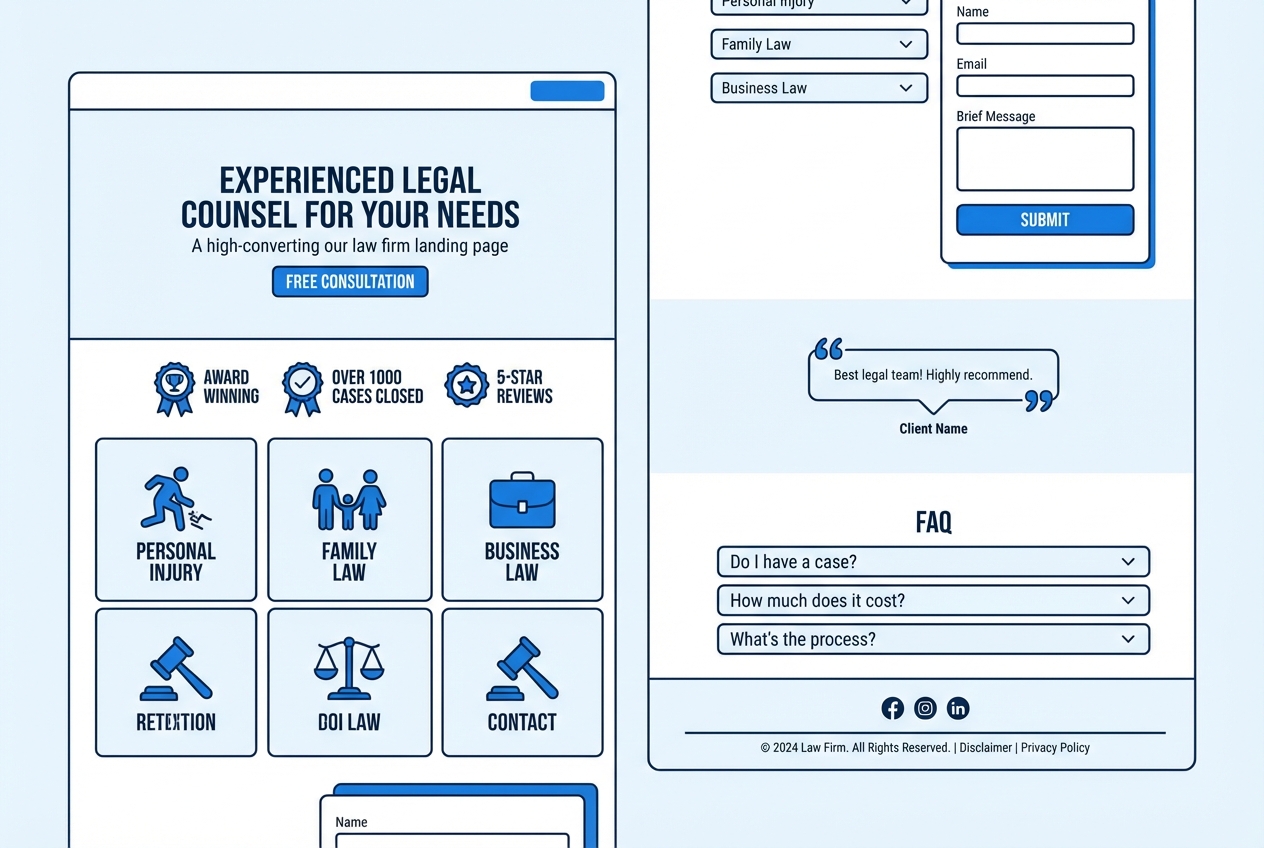
A strong landing page for lawyers earns its length by answering the questions that stop a cautious prospect from reaching out. The goal is a complete decision path, not a long page.
Use this structure as your baseline:
- Hero section: State the case-type promise and make the primary action obvious.
- Proof and credibility: Add fast trust signals above the fold and fuller credibility details below.
- What you handle and what you do not: Be specific so prospects self-select in or out.
- Your process: Explain what happens after they click, in plain language.
- Testimonials or case examples: Share social proof carefully, with context and appropriate disclaimers.
- FAQ: Answer the questions that delay action, including process and expectations.
- Second and third call to action: Repeat the call to action (CTA) at natural decision points.
- Footer disclosures and contact details: Include required disclosures and clear ways to reach you.
Hero section: make the promise clear and the action obvious
Your hero should do three things in a few seconds:
- Say who you help: “Injured in a car accident in [City]?”
- Say what happens next: “Talk to an attorney today” or “Request a consultation.”
- Offer an immediate action: Two buttons is usually enough, such as “Call now” and “Request a consultation.”
Add a short supporting line that reduces uncertainty without overpromising:
- Response-time reassurance: “Same-day callbacks when available.”
- Human contact reassurance: “You will speak with a real person.”
Avoid making outcomes sound guaranteed.
Proof and credibility: show “why trust you” in seconds
Put lightweight trust signals above the fold, then expand them lower on the page:
- Bar admissions and jurisdictions: Keep it factual and current.
- Years in practice and focus areas: Describe your experience without implying outcomes.
- Reviews and third-party ratings: Use only accurate, current sources, and avoid selective edits that change meaning.
- Associations and publications: Include only items that are real and relevant to the practice area.
Practice-area fit: be explicit about what you do and do not do
A common win on lawyer landing pages is clarity:
- What we handle: List the matters this page is designed for.
- What we do not handle: List the matters you do not take, to prevent wasted submissions.
This clarity also sets up a better intake flow.
Process: reduce fear by explaining what happens after they click
A simple process block reduces hesitation:
- Step 1: They submit a short request.
- Step 2: Your team reviews the basics.
- Step 3: If it is a fit, you schedule a consult.
Keep it honest. If you do not offer same-day consults, do not imply it.
Expected outcome: you have a reliable page layout that anticipates objections and moves prospects to one next step.
Step 3: Write persuasive copy that stays compliant
Legal advertising rules vary by jurisdiction, but the core risk is consistent: don’t create unjustified expectations.
Start with the baseline principle in the American Bar Association (ABA) Model Rules. Under ABA Model Rule 7.1, communications about a lawyer’s services must not be false or misleading.
The practical landing-page takeaway:
- Be specific about what you mean: “Free consultation” should match your real intake process.
- Frame results carefully: The commentary on Rule 7.1 explains that even truthful statements can mislead if they create unjustified expectations.
- Keep claims evidence-based: The Federal Trade Commission (FTC) is explicit that advertising claims should be truthful and evidence-based in its advertising and marketing basics.
Copy blocks that usually work for lawyer landing pages
Use these as patterns, then tailor them to your case type:
- Problem-first headline: “Charged with DUI in [County]? Get clear next steps today.”
- Authority without hype: “Focused on [practice area]. Serving [city/region].”
- Expectation setting: “Every case is different. We will review your situation and explain your options.”
Phrases that often create avoidable risk
You can still be persuasive. You just want to avoid language that implies certainty:
- Guaranteed outcomes: “We will win your case.”
- Unqualified superlatives: “Best lawyer,” unless you can support it and your jurisdiction allows it.
- Misleading urgency: “Act now or you lose everything,” unless it is tied to a real deadline and you explain it plainly.
Expected outcome: your page reads confidently while staying grounded, specific, and defensible if scrutinized.
Step 4: Add trust signals that matter in legal services
Trust signals should lower perceived risk, not inflate claims.
Prioritize:
- Attorney identity: Name, photo, bar admissions, and a short, factual bio.
- Clear contact methods: Phone, email, office address (as appropriate), and business hours.
- Reviews with context: Keep reviews accurate and avoid edits that change meaning.
- Submission reassurance: Set expectations about response time and what happens next.
If you serve multiple offices or practice groups, consider building separate pages per location and per case type. Larger firms also tend to need governance and role-based access across teams, which is where our enterprise offering fits naturally.
Expected outcome: prospects can quickly answer “Is this firm credible for my situation?” without hunting through your site.
Step 5: Design the intake so it qualifies leads without scaring them off
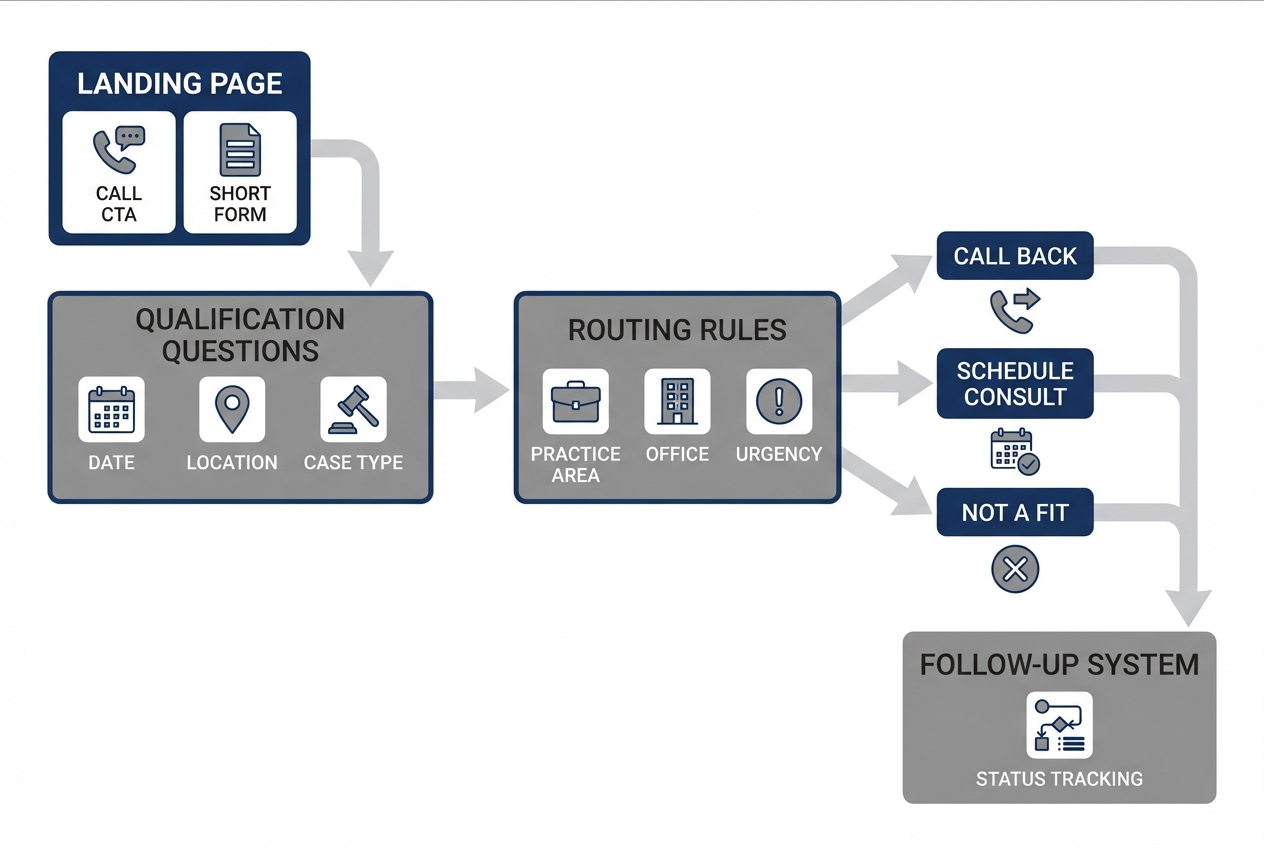
The intake experience is where many lawyer landing pages break. Either the form is too long, or it collects too little to route the lead properly.
A good intake flow has two layers:
- Layer 1 (landing page): A short form that captures contact details and a few qualifying facts.
- Layer 2 (follow-up): A longer questionnaire after the initial response, or during scheduling.
What to ask on the landing page
Keep it short and purposeful:
- Name and best contact method: Capture phone and/or email, based on how you actually respond.
- Case type qualifier: Use a dropdown that matches the page, so your routing stays clean.
- One to three key facts: Ask only what you need to triage, such as “Date of incident” or “Court date.”
- Consent and disclaimers: Confirm the visitor understands your submission terms.
What to say near the form
This is the fastest way to reduce anxiety:
- Confidentiality expectations: Explain how you handle submissions and who sees them.
- No attorney-client relationship disclaimer: Use your firm’s preferred language.
- Conflict checks: If relevant, set expectations about what happens if you cannot represent them.
When a “custom intake app” beats a basic form
If your qualification logic is nuanced (multiple practice areas, multiple offices, multiple handoffs), basic form builders become a bottleneck.
This is where QuantumByte can be genuinely useful: you can describe your intake logic in plain language, then generate a tailored intake workflow that routes leads based on your rules. The practical goal is simple: fewer dead-end submissions and fewer leads going cold.
For a deeper look at what that kind of system can include, see the guide on law firm client intake software. If you want prompt patterns to spec the workflow cleanly, the AI app builder prompts article is a strong starting point.
Expected outcome: your landing page captures enough detail to qualify leads, while keeping the first step fast and low-friction.
Step 6: Make calls, scheduling, and follow-up impossible to miss
A landing page for lawyers is only as good as your follow-up speed.
Build your contact layer intentionally:
- Primary call button: Place it in the hero and keep it sticky on mobile.
- Call tracking (optional): Use it for ad attribution, but ensure it does not degrade call quality or create routing confusion.
- Scheduling (optional): Use it when you have dependable availability and a reliable intake review loop.
- Fast confirmation: After submission, show a confirmation page that explains exactly what happens next.
Operationally, decide who owns the lead:
- Lead owner: Assign the person responsible for first response.
- Back-up owner: Create coverage when that person is unavailable.
- Standard reply window: Set an internal standard you can consistently meet.
Expected outcome: prospects always know how to contact you, and your team can respond consistently instead of improvising.
Step 7: Get mobile speed and accessibility right
Most lawyer landing page traffic is mobile. If your page is slow or hard to use, conversions drop and you can waste ad spend.
Focus on these improvements:
- Keep the page lightweight: Compress images, limit heavy scripts, and avoid auto-playing media.
- Design for thumb use: Use large buttons, readable font sizes, and minimal form fields.
- Use accessible structure: Add clear headings, descriptive labels, and logical tab order.
For a standards-backed reference, the W3C overview of the Web Content Accessibility Guidelines (WCAG) 2.2 is a solid north star.
Expected outcome: your page loads quickly, works smoothly on mobile, and is usable for a wider range of visitors.
Step 8: Launch, test, and iterate with a simple cadence
You do not need endless A/B tests to get value. You need a repeatable rhythm.
Start with:
- Baseline launch: Ship one clear offer, one page, and one conversion goal.
- Weekly review: Track traffic source, click-to-call rate, form starts versus submissions, and lead quality.
- One change at a time: Adjust a single variable per cycle, such as headline, call-to-action (CTA), form length, or trust signals.
If you want a founder-friendly way to think about rapid validation, the guide on testing demand fast provides a practical mental model. And if you are building toward productized services, the landing page validation roadmap shows how to structure early experiments.
Expected outcome: you improve conversion rate and lead quality steadily, without turning optimization into a second job.
Common mistakes that quietly kill conversions
These are fixable, but they are easy to miss when you are busy running a practice:
- Generic headline: “Experienced Attorneys” does not match intent. Use the specific case type and location so the visitor feels understood.
- Competing CTAs: If you offer “Call,” “Email,” “Chat,” “Schedule,” and “Download,” you increase hesitation. Pick one primary action and one secondary.
- Long, defensive forms: Asking for every detail up front reduces submissions. Capture the minimum, then expand later.
- Vague trust signals: “Trusted by thousands” without context can backfire. Use concrete, verifiable credibility.
- Unclear next steps: If a visitor does not know what happens after they submit, they often do nothing.
Choosing the right tool for your lawyer landing page
Many firms can launch a strong page with mainstream site builders. The key is knowing when you are buying simplicity versus flexibility.
| Option | Best for | Trade-offs to watch |
|---|---|---|
| WordPress | Full control and long-term content marketing | Setup and maintenance overhead; plugins can create performance and security issues if unmanaged |
| Webflow | Design-forward pages with good performance | Strong for marketing pages, but custom workflows can require additional tools |
| Unbounce/Instapage | Paid traffic teams shipping fast tests | Great for pages, limited when you need deeper intake logic and routing |
| QuantumByte | When you want the landing page plus custom intake workflows and internal tooling | Best when you are ready to define your intake rules and want software-like flexibility without a long build cycle |
If your current pain is “we get leads but follow-up is chaos,” you are already past the point where a page-only tool is enough.
A practical build path with QuantumByte
If you want to move beyond a static page and toward a landing page plus a real intake system, QuantumByte’s workflow is straightforward.
- Define the intake spec: Turn your landing page requirements into a structured brief once your choose your plan, including practice area, service area, disclaimers, and the exact intake questions you want.
- Generate and iterate quickly: Build the first version fast, then refine based on the leads you actually want, not the leads you happen to get.
- Extend into an intake system: Add routed intake, internal status tracking, and (when it makes sense) a client-facing portal.
When you are ready to build, simply choose your pricing. It is built for founders and operators who want speed without losing control, especially once your “landing page problem” becomes an “intake and follow-up problem.”
Expected outcome: you have a realistic path from “page” to “process,” without taking on a long custom development cycle.
What you now have
You now have a buildable approach to creating a landing page for lawyers that is designed to convert and designed to hold up under scrutiny.
You covered:
- Conversion-first structure: A page layout that matches legal-client intent and repeats one clear next step.
- Compliant persuasion: Copy patterns that sell without drifting into misleading territory.
- Trust signals that matter: Credibility elements that reduce perceived risk for high-stakes decisions.
- Intake as a system: Qualification that balances friction with better lead routing.
- Iteration cadence: A simple launch-review-improve loop that steadily increases lead quality.
If you keep the page focused, keep the next step easy, and treat intake as a system rather than a form, your landing page becomes a reliable growth asset.
Frequently Asked Questions
What should a landing page for lawyers include above the fold?
Above the fold, include a case-type-specific headline, one primary CTA (call or consultation request), a short supporting line that sets expectations, and a small set of credibility markers like jurisdiction, practice focus, and reviews if accurate.
How long should an attorney landing page be?
Long enough to answer the prospect’s top questions and remove doubt, but no longer. For many practice areas, that means a strong hero, credibility, fit, process, testimonials (carefully framed), and FAQ, with CTAs repeated logically.
Can I use testimonials and past results on a law firm landing page?
Often yes, but you should frame them carefully to avoid unjustified expectations. Many jurisdictions have specific rules. Use clear context, avoid implying guaranteed outcomes, and consider disclaimers where appropriate.
Should I use a short form or a long intake form?
Use a short form on the landing page to increase completions, then collect deeper details in a follow-up step. Long forms can work only when intent is very high and the visitor trusts you already.
What is the best CTA for a lawyer landing page: call or schedule?
Calls usually reduce friction for urgent matters. Scheduling works well when you can reliably honor availability and have a process for reviewing submissions quickly. If you choose scheduling, keep a call option visible for visitors who want immediate help.
When should a law firm consider building a custom intake workflow?
When lead routing is complex, when multiple offices or practice areas share the same pipeline, or when lead quality is inconsistent. If your team is spending too much time triaging and following up manually, a custom workflow can be the difference between growth and overwhelm.