
You do not need a “pretty website” to win more clients. You need a real estate agent landing page that makes one promise, builds trust fast, and turns the right visitors into booked calls or qualified leads.
This guide shows you how to build that page step by step, with proven page structure, copy blocks you can reuse, and the tracking and compliance details that keep campaigns scalable.
What a real estate agent landing page must do
A landing page is a single-purpose page designed to convert one traffic source (ads, social, Google Business Profile, email, QR code, referral partners) into one next action. Unlike a homepage, it removes detours so visitors can decide quickly.
A high-performing real estate landing page does three jobs well:
- Focus attention: It removes navigation clutter and gives the visitor one clear “next step.”
- Pre-qualify: It makes it easy for the right prospects to raise their hand and discourages time-wasters.
- Prove credibility: It answers “Why you?” without forcing the visitor to hunt.
If you are running multiple offers, you will usually want multiple landing pages. One page per intent beats one page for everyone.
Choose one goal before you design anything
The biggest conversion killer is trying to serve buyers, sellers, renters, investors, and recruits on the same page.
Pick one primary goal and build everything around it.
Here are common real estate landing page goals that work well:
- Generate seller leads: Offer a home valuation, pricing strategy call, or “sell in 60 days” plan.
- Generate buyer leads: Offer a curated list of homes, a neighborhood guide, or access to listings.
- Book appointments: Drive directly to a 15-minute consult or showing request.
- Capture relocation leads: Offer a relocation checklist, school guide, or commute-based neighborhood shortlist.
In our opinion, a useful way to decide is to look at where your traffic comes from:
- Paid ads: If your leads come from Meta ads, pick one offer per ad set so the message match stays tight.
- SEO: If your leads come from search, create a page per neighborhood or property type so the page answers the exact query intent.
- Referrals: If your leads come from referrals, create a short page that reassures and books the call, because the visitor’s main need is confirmation and next steps.
Map the page layout that converts
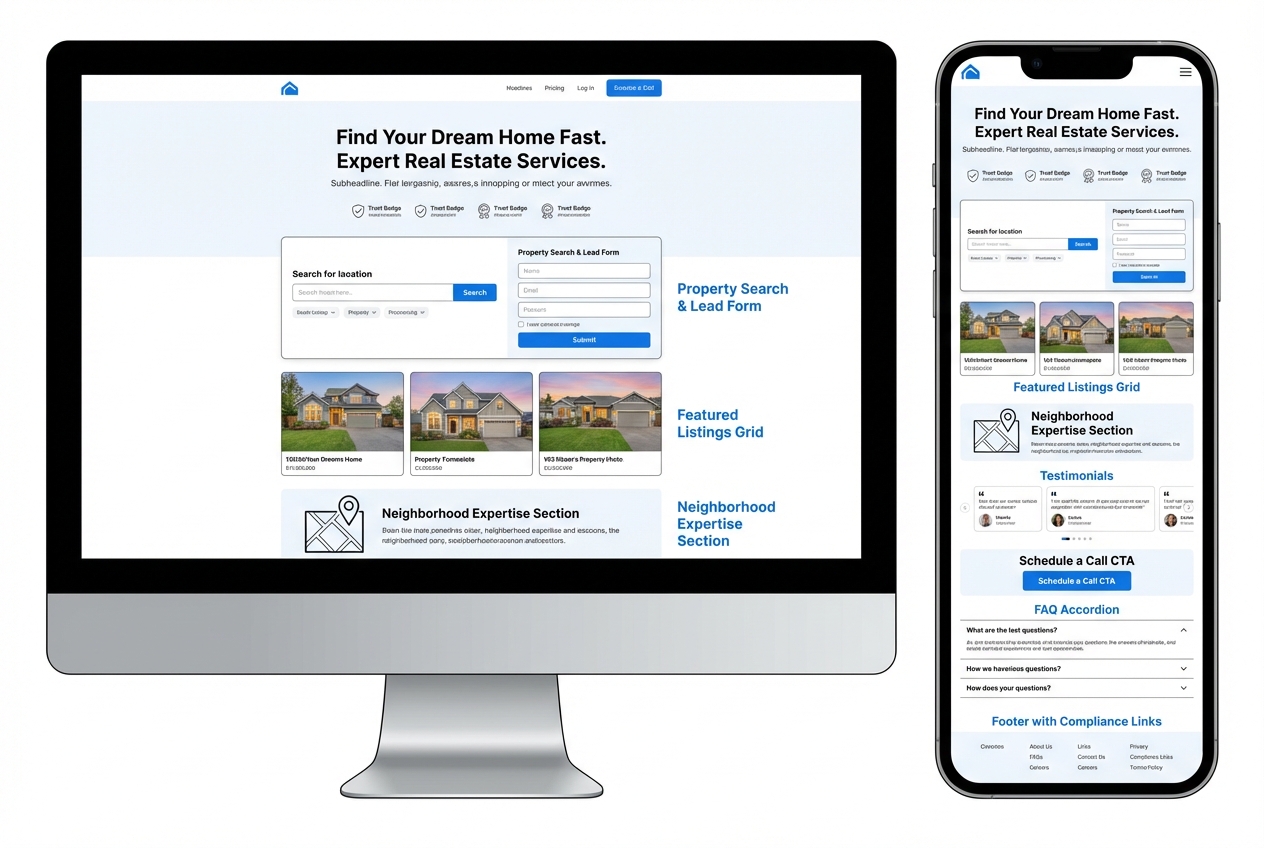
Use a simple, scannable structure. You are optimizing for a fast decision, not a deep read.
A reliable real estate agent landing page layout looks like this:
- Hero: State the outcome, location, and the one action you want taken.
- Trust proof: Reduce doubt with reviews, brokerage details, and recognizable credibility signals.
- Offer details and what happens next: Explain the deliverable and set expectations so the lead feels safe.
- Lead capture: Use a form or scheduling that matches the offer and the visitor’s intent.
- Local expertise section: Prove you know the micro-market with specifics, not slogans.
- Testimonials and recent results: Show proof that maps to the visitor’s situation.
- FAQ: Answer objections that block action (timelines, fees, privacy, process).
- Compliance, privacy, contact info: Protect your ad accounts and make the page trustworthy.
The main idea: every section should either reduce uncertainty or increase intent.
Write the hero section in 5 minutes
Your hero is the conversion engine. It should make your offer instantly obvious.
Use this simple formula:
- Headline: Outcome + location + audience
- Subheadline: Mechanism + timeframe (if true) + what they get
- Primary call to action: One action verb
- Secondary reassurance: One short trust note
Examples you can adapt:
- Seller headline: "Sell your Austin home with a pricing plan you can trust."
- Seller subheadline: "Get a data-backed valuation and a 30-minute strategy call. No pressure, no obligation."
- Primary call to action: "Get my valuation."
- Reassurance line: "Local agent. Fast response. Clear next steps."
Keep it specific. “Top realtor” is vague. “Negotiated 17 offers in 2025” is specific, but only if you can prove it.
Build trust without making the page feel salesy
Real estate decisions are high-stakes. Visitors look for credibility signals that feel verifiable.
Use trust elements you can support:
- Licensing details: Add your license number and brokerage name where required.
- Social proof: Reviews, testimonials, short quotes, and recognizable platforms.
- Local authority: Neighborhood-specific knowledge, not generic “I love helping clients.”
- Process clarity: A short “How it works” reduces anxiety.
A tight “How it works” block can be as simple as:
- Step 1: “Tell me your timeline and your address.”
- Step 2: “I review comps and your property details.”
- Step 3: “You get a pricing plan and next steps within 24 hours.”
Design the form so people actually complete it
Most landing pages fail at the form. It is either too long, too intrusive, or unclear.
Use these practical rules:
- Ask for less up front: Name + email + phone is often enough. Add more fields only if you truly need them.
- Make the reason obvious: If you ask for a phone number, explain what you will do with it.
- Match the offer: A “book a showing” page should use scheduling. A “valuation” page can start with a form.
Strong, specific form prompts:
- Location prompt: "What neighborhood are you focused on?"
- Timeline prompt: "Are you buying in the next 0–3, 3–6, or 6+ months?"
- Contingency prompt: "Do you need to sell before you buy?"
Avoid sensitive questions that are not essential.
Pick the right page type for your funnel
Different offers need different landing pages. Use this table to avoid mismatches.
| Page type | Best for | Primary call to action | Key sections to include |
|---|---|---|---|
| Home valuation | Sellers with intent | “Get my valuation” | Comps/process, timeline question, testimonials from sellers |
| Buyer consult | First-time buyers, relocations | “Book a call” | Your process, lender and inspection guidance, neighborhood expertise |
| Featured listings | Warm traffic, social followers | “Get listing alerts” | Listings grid, saved search value, email/SMS preferences |
| Neighborhood guide | SEO traffic | “Get the guide” | Map highlights, schools/commute notes, FAQs, internal links to related areas |
If you are unsure, start with one page for sellers and one for buyers. Iterate from there.
Set up tracking so you know what is working
If you cannot attribute leads, you cannot scale.
At minimum, track:
- Form submits: Your core conversion event.
- Booked appointments: If you use scheduling.
- Calls and texts: If your traffic is mobile-heavy.
- Source and campaign: So you can compare ad sets, keywords, and partners.
Practical implementation notes:
- Use a dedicated thank-you page: It makes conversion tracking cleaner than relying on a “form submitted” popup.
- Use UTM parameters: A simple UTM (Urchin Tracking Module) convention keeps attribution consistent across channels.
- Connect to your CRM: Customer Relationship Management tools prevent leads from dying in your inbox.
If you build multiple pages, keep your event names consistent so reporting does not become a mess.
Handle performance basics that impact both SEO and conversions
Page speed affects how many visitors stay long enough to read, trust you, and take action. It also influences search visibility when you rely on organic traffic.
Google’s Core Web Vitals initiative defines key user experience metrics like Largest Contentful Paint (LCP), Cumulative Layout Shift (CLS), and Interaction to Next Paint (INP) on its official guidance hub at web.dev.
Focus on a few high-impact moves:
- Compress images: Export in modern formats when possible and avoid huge hero images.
- Keep the page lightweight: Too many widgets, popups, and trackers slow things down.
- Stabilize layout: Reserve space for images and embeds so the page does not jump during load.
- Use one clear font system: Multiple font families and weights add unnecessary requests.
Keep your page compliant for real estate marketing
Compliance is a conversion topic because it affects where you can run ads, what you can say, and how confidently you can scale.
Start with fair housing basics. The U.S. Department of Housing and Urban Development (HUD) overview of the Fair Housing Act explains protected classes and the core purpose of the law. Make sure your copy, imagery, and targeting do not imply preference or exclusion.
If you run Meta ads for listings or housing-related services, you also need to understand the platform rules. Meta’s documentation on the Marketing API outlines restrictions for the Housing special ad category that can affect targeting options and campaign setup.
Practical landing page compliance habits:
- Avoid exclusionary language: Do not imply preference for a protected group.
- Use inclusive imagery: Aim for representation that reflects your market.
- Add privacy and consent clarity: If you collect phone numbers, state what messages they will receive and how often.
- Disclose brokerage details when required: Rules vary by region and brokerage.
If you work in multiple states or countries, treat compliance as a system, not an afterthought.
Build faster with reusable components instead of starting from scratch
If you are building landing pages repeatedly, the time sink is usually rebuilding the same structure, form logic, and follow-up flows. When you standardize those building blocks, you can ship new pages for neighborhoods, services, or campaigns without redoing the plumbing.
This is where an app builder can be a real advantage because you can turn your best-performing real estate agent landing page into a reusable template, then spin up variations quickly.
QuantumByte is designed for this style of work. You describe the page and the workflow you want, and it generates a working app experience quickly, including the parts that are usually annoying to wire up like lead capture, routing, and internal tools. If you want a practical starting point, the Packets workflow helps you turn “what I want this page to do” into structured requirements that are easier to build and iterate.
If you want to sharpen your prompt so the output is predictable, use the templates in AI app builder prompts.
A simple build process you can follow this week
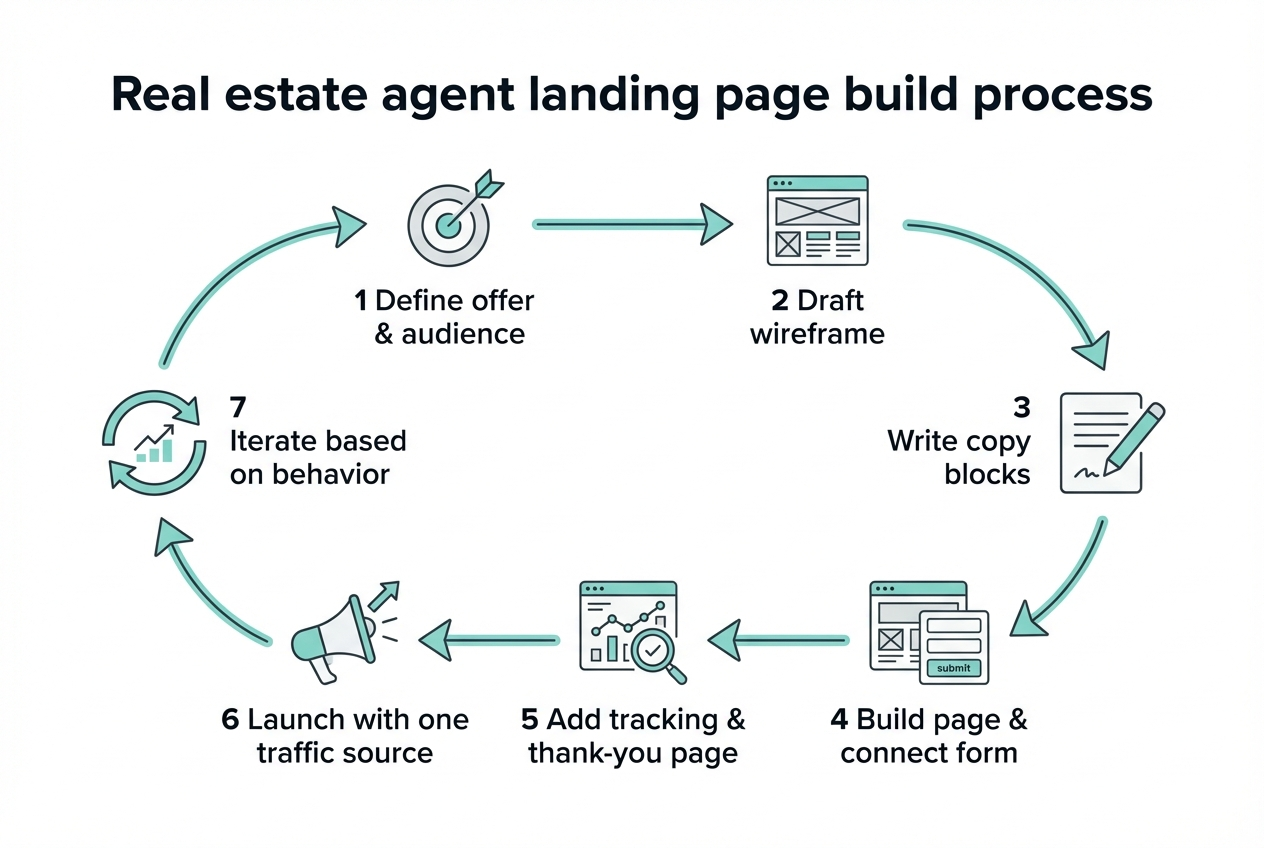
You do not need perfection to launch. You need a clean first version and a plan to iterate.
- Define one offer and one audience:
Start here because a landing page only converts cleanly when the visitor knows exactly what they get and who it is for. Your expected outcome is a one-sentence promise you can repeat everywhere, including in ads and follow-up messages.
- Draft the wireframe:
Sketch the section order before you write copy because structure drives clarity. When you wireframe first, you avoid burying the form, overloading the page with extras, or letting “nice to have” sections crowd out the conversion path. Your expected outcome is a simple layout that you can build quickly and test.
- Write copy in blocks:
Draft the hero, “How it works,” testimonials, and FAQs as separate blocks because landing page copy is easier to improve when it is modular. Your expected outcome is faster iteration, since you can swap one block (like the hero) without rewriting the whole page.
- Build the page and connect the form:
Build with the goal of getting one reliable lead into your system. The page is only useful if submissions reach you consistently and land in the right place. Your expected outcome is a working lead flow that routes to email, a Customer Relationship Management tool, and a calendar if the offer requires scheduling.
- Add tracking and a thank-you page:
Add measurement before you scale spend or publish more pages. A dedicated thank-you page makes conversion tracking cleaner and helps you confirm attribution with UTMs. Your expected outcome is the ability to answer a basic question with confidence: which traffic source and offer produced this lead?
- Launch with one traffic source:
Start with one channel so your results are interpretable. When you launch across multiple channels at once, it becomes harder to diagnose what is working and what is noise. Your expected outcome is clean learning, including which headline, offer, and form friction points matter most.
- Iterate based on real behavior:
Make one meaningful change at a time (hero headline, proof section, form fields, or CTA) so you can attribute wins to the correct variable. Your expected outcome is steady conversion improvement without breaking what already works.
If you are deciding whether to custom-build or use an off-the-shelf page builder, the framework in custom business software development: when to build vs. buy is a useful reality check.
Common mistakes that quietly kill conversions
These are the patterns that make a landing page look “fine” while it underperforms.
- Too many calls to action: If you ask visitors to call, text, email, book, and download, most will do none.
- Generic positioning: “Trusted local expert” is not a reason to choose you. Specific experience is.
- Overlong forms: Qualification questions are good, but only after you have earned the right to ask.
- No follow-up system: Speed-to-lead matters. If you cannot respond consistently, simplify your funnel.
- Mismatch between ad and page: If the ad says “condos in Downtown,” the page must deliver that, immediately.
If you want to see how operators use “vibe coding” to build fast internal tools around marketing and ops, the examples in vibe code custom ecommerce ops tools map well to real estate workflows too.
Choosing the right tool for your landing page
Most real estate agents start with a website builder. That is fine, but landing pages often need more than a page editor.
Here is a practical way to think about it:
| Option | Best when | Trade-offs |
|---|---|---|
| Traditional website builders (Wix, Squarespace) | You want something simple and design-led | Custom lead routing, experiments, and workflow automation can get clunky |
| Conversion landing page tools (Unbounce, Leadpages) | You want fast A/B tests and ad-focused pages | You still need to integrate CRM, follow-up, and internal processes |
| Real estate platforms (IDX sites, CRM suites) | You want a packaged ecosystem | Customization and speed of iteration can be limited depending on vendor |
| AI app builders (QuantumByte) | You want landing pages plus the workflows behind them | You need to be clear about your requirements so the build matches your process |
If you are a solo agent or small team trying to scale without hiring more admin help, an AI app builder can be the best fit because the “page” and the “process” can ship together.
QuantumByte is the option to choose when you want a landing page that does not stop at lead capture. It can also generate the lightweight internal app you actually need: lead triage, follow-up tasks, showing requests, and a simple pipeline. For founders and operators, that full-system approach is usually where the return comes from.
If you are curious what “build fast without prior experience” looks like in practice, the Aziz Ansari Good Fortune story is a good example of rapid app creation and rollout.
What you should have after following this guide
You now have a practical blueprint for building a real estate agent landing page that converts:
- Single-goal strategy: A single-goal strategy aligned to one audience and one traffic source
- Conversion layout: A proven page layout that reduces uncertainty and drives action
- Reusable copy blocks: Copy blocks for a strong hero, trust proof, and a simple “how it works”
- Attribution and iteration: Form and tracking guidance so you can attribute leads and iterate
- Performance and compliance guardrails: Performance and compliance guardrails, including fair housing and Meta housing ad constraints
If you want to move fast without rebuilding the same components every time, start by turning your offer into a structured spec in Packets. That is the fastest path to a landing page you can duplicate, refine, and scale into a real lead system.
Frequently Asked Questions
How long should a real estate agent landing page be?
Long enough to answer obvious objections and short enough to keep momentum. For cold traffic, you typically need a strong hero, trust proof, a clear offer, and a small FAQ. If your offer is complex (relocation, investment, luxury), add more clarity and examples rather than more hype.
Should I use a form or a booking calendar?
Use a form when you need to qualify (timeline, neighborhood, price range). Use a booking calendar when the visitor intent is already high and your next step is a conversation. Many agents use both: form first, then offer booking on the thank-you page.
Do I need Multiple Listing Service access on the landing page?
Not always. Multiple Listing Service (MLS) and Internet Data Exchange (IDX) features can help, but a landing page can convert well with a focused offer like a consult, valuation, or neighborhood guide. Add listings only when they directly support the promise.
What should I offer to capture seller leads?
A valuation can work, but the best offer is usually a clear outcome plus a process. For example: “pricing strategy + timeline plan,” “prep checklist + vendor plan,” or “net sheet estimate.” Sellers want confidence and next steps, not just a number.
Can one landing page serve buyers and sellers?
It can, but it usually underperforms. If you have mixed traffic, use separate pages and route visitors based on intent. You will get cleaner tracking and higher conversion rates.
What legal links should I include in the footer?
At minimum, include a privacy policy and a clear way to contact you. Add brokerage and licensing details if required in your market. When in doubt, align with your brokerage compliance guidance and local regulations, and keep your language consistent with fair housing principles.