You want to ship client software faster without hiring a bigger team or drowning in specs. Vibe coding for agencies is the fastest path there, as long as you run it with the right guardrails so speed does not turn into rework.
How Agencies Can Leverage Vibe Coding
Great fits:
-
Internal tools: dashboards, admin panels, approvals, reporting, and simple automations.
-
Client portals: login, onboarding forms, document collection, status tracking.
-
Proofs of concept: validating an idea, pricing model, or workflow before a full build.
-
Workflow-heavy apps: anywhere the "steps" matter more than pixel-perfect visuals on day one.
Where you should be cautious:
-
Regulated systems: finance, health, or critical infrastructure often need deeper verification, audit trails, and strict controls.
-
Complex integrations: multiple external systems with brittle edge cases can turn "fast" into "fragile."
-
High-scale consumer apps: performance, observability, and reliability become first-class features.
If your client is deciding whether custom software is even the right move, use the build-vs-buy filter first. We covered custom business software build vs buy, which is a practical decision framework.
Vibe Coding Workflows for Agencies
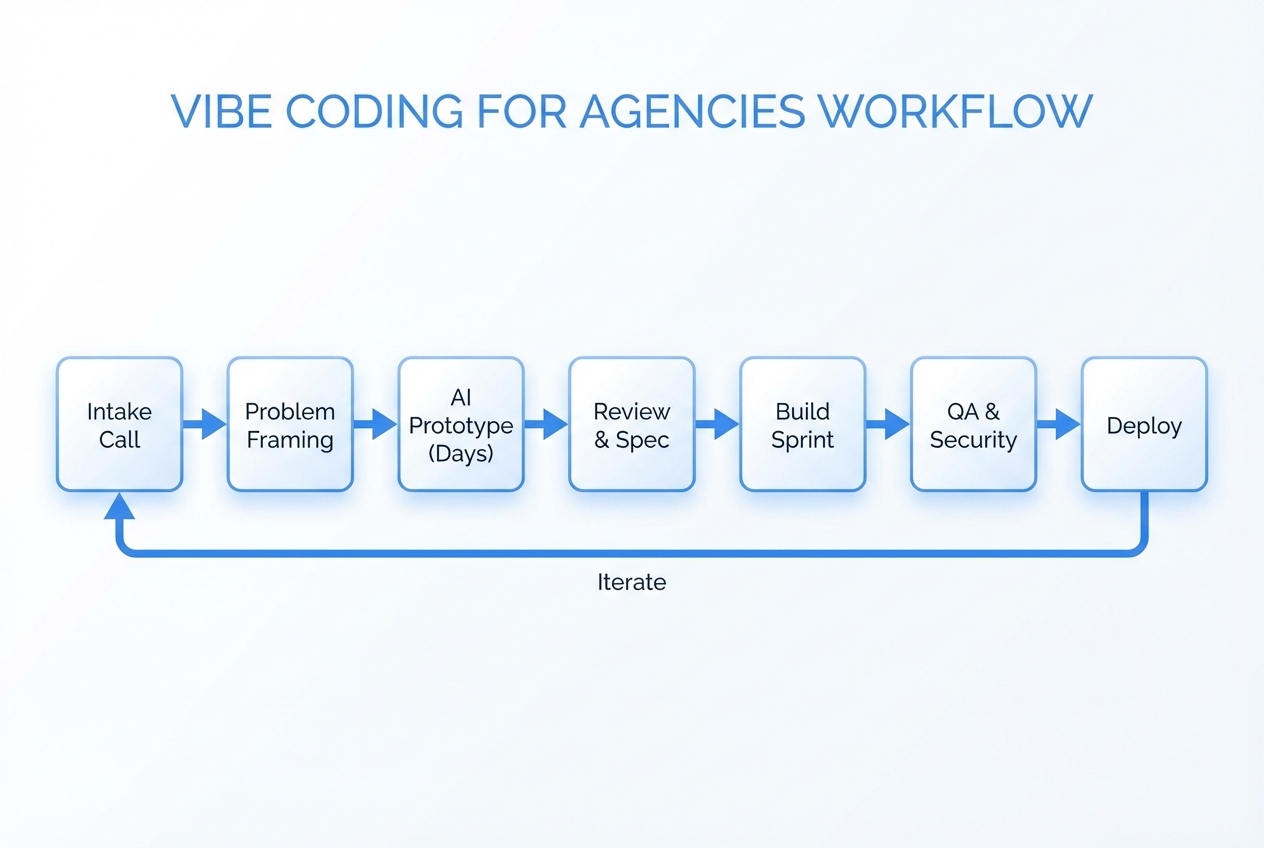
The winning agencies treat vibe coding as a delivery system with guardrails. When you run it that way, it stays fast and stays trustworthy.
A reliable workflow looks like this:
-
Intake and problem framing: clarify the outcome, users, constraints, and success metrics.
-
AI prototype: generate a working draft quickly to surface missing requirements.
-
Review and spec: convert what you learned from the prototype into a short, testable scope.
-
Build sprint: harden the prototype, integrate real data, and handle edge cases.
-
Quality assurance (QA) and security: test flows, permissions, and failure modes.
-
Deploy and iterate: ship, measure, and improve based on real use.
That is the core idea: prototype fast, then earn trust through discipline.
A Step-by-Step Guide to Vibe Coding for Agencies
Step 1: Start with outcomes, not features
Your client will ask for features because that is what they can see. Your job is to translate that into outcomes.
Aim to leave the first call with:
-
Primary job-to-be-done: what the user is trying to accomplish in one sentence.
-
Top three workflows: the paths users run every day.
-
Definition of done: what "success" looks like in production.
This framing also helps you avoid building software that should have been a process change.
Step 2: Turn the problem into a one-page "build brief"
A build brief is a short document that makes AI output useful and keeps your team aligned.
Include:
-
Users and roles: who logs in and what each role can do.
-
Data objects: the nouns of the system (clients, orders, tickets, invoices).
-
Workflow rules: approvals, statuses, and what triggers what.
-
Constraints: must-have integrations, compliance needs, hosting preferences.
If you want prompt structures that translate cleanly into app plans, keep QuantumByte's AI app builder prompt templates handy. Even if you use a different tool, the format is reusable.
Step 3: Build a prototype that proves the workflow
Your goal is a demo that proves you are building the right thing. It does not need to look finished.
A good prototype:
-
Uses realistic sample data: enough to reveal edge cases.
-
Implements the core happy path: at least one end-to-end workflow.
-
Shows role-based access: even if it is basic at first.
This is also the moment to pick your development approach. Some projects fit no-code tools. Others need real code. Many land in the middle. If you want a clear comparison, see no code vs vibe coding.
Step 4: Run a structured prototype review with the client
Do not "send the link and ask for thoughts." Lead a review that forces clarity.
In 30 to 45 minutes, you want decisions on:
-
What stays: workflows that match reality.
-
What changes: missing steps, extra roles, confusing screens.
-
What waits: non-essential features that can ship later.
Capture feedback as testable statements (example: "An account manager can approve discounts up to 10% without finance"). It will save you later.
Step 5: Convert the prototype into a scoped sprint plan
Now you shift from discovery speed to delivery reliability.
Break work into:
-
Foundation: data model, auth, permissions, environment setup.
-
Integrations: application programming interface (API) connections, webhooks, imports.
-
Core workflows: the paths you promised in the build brief.
-
Edge cases: failures, retries, validation, audit logs.
This is also where agencies win with transparency. Your client should understand what is included, what is not, and what "phase 2" means.
Step 6: Harden quality with real testing habits
AI can draft code, but it cannot be the final judge of correctness.
Build a lightweight QA cadence:
-
Happy path tests: prove the main workflows work.
-
Permission tests: prove the wrong user cannot see or do the wrong thing.
-
Data validation tests: prove the system rejects bad inputs.
-
Regression tests: prove you did not break yesterday's work.
If your agency is building web apps, align your risk checks to the OWASP Top 10 so your team has a shared language for common security problems.
Step 7: Add security and governance before you scale the method
If you plan to make vibe coding a repeatable delivery model, treat security as something you keep doing. A one-time scan will not protect you as the app evolves.
A practical baseline:
-
Threat modeling: list what can go wrong and how you will prevent it.
-
Secure defaults: least privilege access, safe file upload handling, input validation.
-
Dependency hygiene: know what libraries you ship and keep them patched.
-
Release gates: do not deploy without a minimum set of checks.
Microsoft's overview of the Security Development Lifecycle (SDL) is a useful reference for what "security built in" looks like.
If you build with LLMs in the loop (chat features, AI agents, content generation), also study LLM-specific risks like prompt injection and insecure output handling. The OWASP Top 10 for LLM Applications is a clear starting point.
For teams making bigger bets on AI, the NIST AI Risk Management Framework helps you think about trustworthiness and operational risk in plain terms.
Step 8: Deploy, measure, and keep momentum
A strong launch is boring in the best way. It is repeatable.
Plan:
-
Rollout: pilot users first, then expand.
-
Observability: logs and basic metrics so you can debug fast.
-
Feedback loop: one channel for issues, one cadence for upgrades.
This is where you lock in long-term relationships. Clients love agencies that ship and improve.
Tool stack for vibe coding in an agency
Your stack should match the kind of projects you sell. Most agencies do well with a "prototype fast, then harden" setup.
Common building blocks:
-
AI coding environment: tools like Cursor, GitHub Copilot, or similar can speed up implementation, but you still need code review habits.
-
Rapid app builders: great for internal tools and portals when speed matters more than custom infrastructure.
-
Traditional development: required when you need unusual integrations, custom performance work, or strict security controls.
A practical option for agencies is a hybrid approach: generate a real app fast, then bring in senior engineers when the last 20% gets tricky.
QuantumByte is built for that model. You can start with AI-generated scaffolding and workflows, then lean on a human team when you hit edge cases or need deeper custom work.
Pricing and packaging vibe coding services
Clients buy clarity more than they buy code. Packaging helps you sell clarity.
Here are three packages agencies commonly use:
| Package | Best for | What you deliver | How you sell it |
|---|---|---|---|
| Prototype Sprint | New ideas, unclear requirements | Working demo, defined workflows, phase 2 plan | Fixed price, fast timeline |
| Build Sprint | Proven workflow, real users waiting | Production-ready v1, integrations, QA baseline | Fixed scope with change control |
| Retainer Iteration | Ongoing optimization | Monthly improvements, support, roadmap execution | Predictable budget, compounding value |
To avoid margin loss, be explicit about what is not included in each package.
Common exclusions include:
-
New integrations: if the client wants "just one more system" connected mid-sprint, it changes scope and risk.
-
Major design changes: layout overhauls and new page types belong in a separate design and build cycle.
-
Data migrations: moving messy historical data into a new model often needs dedicated planning and testing.
-
Compliance audits: formal audits and certification-style work require separate timelines and specialists.
If a client is stuck debating whether to hire developers or use modern tools, point them to hiring a developer vs no-code. It helps reset expectations around timelines and hidden costs.
Where QuantumByte fits for agencies
If you are serious about vibe coding as a service line, you need two capabilities:
-
A fast way to generate a usable first version: so you can sell outcomes, not promises.
-
A way to finish strong: because clients remember reliability. Prototypes are only a starting point.
QuantumByte is positioned as both.
-
AI-first creation: you can turn a plain-English brief into a working starting point quickly.
-
Enterprise Support: when AI output hits limits, QuantumByte's enterprise support ensures that your product is able to take the build across the finish line.
Frequently Asked Questions
Is vibe coding just "prompting" an AI to write code?
No. Prompting is one skill inside the process. Vibe coding for agencies is a full delivery method: framing outcomes, generating a prototype, tightening scope, hardening quality, and shipping safely.
Can I sell vibe coding projects as fixed-price work?
Yes, if you scope to workflows and outcomes. Fixed-price works best for Prototype Sprints and tightly defined Build Sprints. For anything with unknown integrations or unclear data, price a discovery sprint first.
What is the biggest failure mode for agencies?
Skipping the "review and spec" phase after the first prototype. If you do not turn prototype learning into testable scope, you will ship a fast demo and then drown in revisions.
How do I protect client data when using AI tools?
Treat AI use like any other vendor risk. Avoid pasting sensitive production data into prompts, define what is allowed, and build internal rules for access and logging. If you deploy LLM features, review LLM-specific risks in the OWASP guidance.
Do I still need senior engineers?
Yes. You need senior engineers for architecture decisions, integration edge cases, security, and performance. Vibe coding reduces time spent on boilerplate. It does not remove responsibility.
How do I explain vibe coding to a non-technical client?
Frame it as "we will show you a working version early, then refine it." Clients care about seeing the workflow and making decisions quickly.
Should an agency use no-code tools instead?
Sometimes. If the workflow is simple and the tool's limits match the client's needs, no-code can be a great choice. If you need more flexibility, vibe coding usually gives you a better middle ground. The comparison in no code vs vibe coding can help you decide.